
Astigmatism
What is Astigmatism?
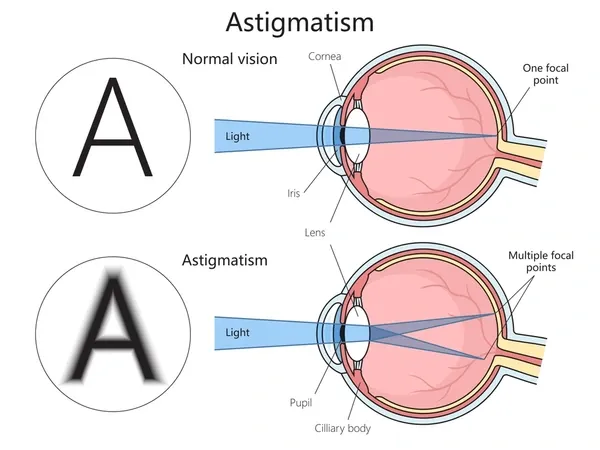
Astigmatism is a common refractive error of the eye, characterized by an irregular curvature of the cornea or lens. This imperfection causes light entering the eye to be focused unevenly on the retina, leading to distorted or blurred vision. Unlike nearsightedness (myopia) or farsightedness (hyperopia), which results from the eye being too long or too short, astigmatism occurs because of an asymmetrical shape of the cornea or lens, which can be likened to an oval football rather than a perfectly round basketball.
What are the symptoms of Astigmatism?
Astigmatism symptoms can vary depending on the severity of the condition. Common symptoms include:-
- Blurred or distorted vision: – Both near and distant objects may appear blurry or stretched.
- Eye strain – Prolonged reading or focusing on screens can lead to discomfort.
- Headaches – The strain from trying to focus clearly can cause frequent headaches.
- Squinting – People with astigmatism often squint in an attempt to see more clearly.
- Difficulty with night vision – Driving or seeing in low light conditions can become challenging.
What causes Astigmatism?
Astigmatism primarily arises from the following causes:-
- Irregular Corneal Shape – The most common cause is an irregularly shaped cornea, known as corneal astigmatism. Instead of being perfectly spherical, the cornea is more curved in one direction, leading to distorted vision.
- Lens Shape – Less commonly, astigmatism may be due to an irregularly shaped lens inside the eye, known as lenticular astigmatism.
- Genetics – Astigmatism often runs in families, indicating a genetic predisposition.
- Eye Injuries or Surgery – Trauma to the eye or certain types of eye surgery can also lead to astigmatism.
- Keratoconus – This is a progressive eye disease where the cornea thins and becomes more cone-shaped over time, resulting in a form of astigmatism.
How is Astigmatism diagnosed?
Astigmatism is typically diagnosed through a comprehensive eye exam, which includes several tests:-
- Visual Acuity Test – This standard test measures how well you can see at various distances. It involves reading letters on a chart to determine the sharpness of your vision.
- Keratometry – This test measures the curvature of the cornea by analyzing how light reflects off its surface. It helps determine the degree and axis of astigmatism.
- Corneal Topography – This advanced test creates a detailed map of the cornea’s surface, providing precise measurements of its curvature. It’s especially useful for detecting irregular astigmatism and conditions like Keratoconus.
- Refraction Test – This test determines the correct prescription for glasses or contact lenses. The eye doctor uses a device called a Phoropter and asks you to choose which lens combinations provide the clearest vision.`
What are the treatment options for Astigmatism?
Astigmatism can be effectively managed and treated through several approaches:-
Corrective Lenses –
- Eyeglasses – The most common and simplest treatment involves wearing glasses with lenses that compensate for the uneven curvature of the cornea or lens.
- Contact Lenses – Toric contact lenses are specially designed to correct astigmatism by conforming to the shape of the eye. Rigid gas-permeable (RGP) lenses can also correct astigmatism by reshaping the cornea during wear.
Refractive Surgery –
- LASIK (Laser-Assisted In Situ Keratomileusis) – LASIK is a popular surgical option where a laser is used to reshape the cornea, correcting the curvature and improving vision.
- PRK (Photorefractive Keratectomy) – Similar to LASIK, PRK involves removing a small amount of corneal tissue to reshape the cornea. Unlike LASIK, PRK doesn’t involve creating a corneal flap.
- LASEK (Laser Epithelial Keratomileusis) – A variation of PRK, LASEK involves loosening the corneal epithelium and then using a laser to reshape the cornea.
- Astigmatic Keratotomy (AK) – Small incisions are made in the cornea to help it become more rounded. This procedure is less common but can be effective for some cases of astigmatism.
- Orthokeratology (Ortho-K) – This non-surgical option involves wearing specially designed contact lenses overnight to temporarily reshape the cornea. Upon removing the lenses in the morning, vision is clearer without glasses or contacts during the day.
Can Astigmatism be cured?
While there is no permanent cure for astigmatism, the condition can be effectively managed. Treatments like corrective lenses or refractive surgery can significantly improve vision. In some cases, vision correction may be so successful that it feels like a cure, but the underlying irregularity of the cornea or lens remains.
Can Astigmatism be prevented?
Astigmatism itself cannot be prevented, as it is often a congenital condition. However, certain measures can help maintain overall eye health and potentially prevent the worsening of astigmatism:-
- Regular Eye Exams – Early detection of astigmatism through routine eye exams can prevent the condition from worsening and ensure that corrective measures are taken promptly.
- Protective Eyewear – Wearing protective eyewear during activities that risk eye injury can help prevent trauma-induced astigmatism.
- Good Eye Care Practices – Practicing good eye hygiene, avoiding eye strain, and protecting the eyes from UV rays by wearing sunglasses can contribute to overall eye health.
What is the outlook for someone with Astigmatism?
The outlook for individuals with astigmatism is generally positive, especially with proper management. Most people can achieve clear vision with the right corrective lenses or surgical interventions. Refractive surgeries like LASIK have high success rates, with many patients experiencing significant improvement in their vision. Regular monitoring is important, as astigmatism can change over time, particularly in younger individuals.
Can Astigmatism get worse over time?
Astigmatism can change, either improving or worsening, as the eye develops or due to factors like aging or eye injury. Regular eye exams are crucial to monitor these changes and adjust the prescription as needed.
How does Astigmatism affect daily life?
Living with astigmatism can be challenging, particularly if it is not corrected. Individuals may struggle with activities that require clear vision, such as reading, driving, or using digital devices. Eye strain and headaches can also affect productivity and quality of life. However, with appropriate correction, most people with astigmatism lead normal, active lives without significant limitations.
What tips can help manage Astigmatism day-to-day?
- Use Proper Lighting – Ensure adequate lighting when reading or working to reduce eye strain.
- Take Breaks – Follow the 20-20-20 rule (every 20 minutes, look at something 20 feet away for 20 seconds) to alleviate eye strain.
- Wear Corrective Lenses – Consistently wearing prescribed glasses or contacts ensures the best possible vision.
- Follow Up – Regular eye check-ups help monitor changes in vision and update prescriptions as necessary.
- Consider Surgery – If glasses or contacts are not providing adequate correction or comfort, consider discussing surgical options with your eye doctor.
Astigmatism is a manageable condition, and with the right approach, individuals can maintain clear vision and a high quality of life. Regular eye care and adherence to treatment recommendations are key to living comfortably with astigmatism.
Why Choose Tender Palm Eye Hospital for Astigmatism Treatment in Lucknow, India?
Tender Palm Eye Hospital, owned by doctors, is renowned for attracting the most skilled professionals in the country. With the finest ophthalmologists specialized in eye diseases, including astigmatism, Tender Palm Eye Hospital stands out as the premier ophthalmology hospital in Lucknow, India. Boasting cutting-edge infrastructure and advanced technology, Tender Palm ensures top-notch medical care for its patients.

